How to Design a Plan for Sustainable High Performance

Most executives plan their calendars as if every hour were equally productive – meetings back-to-back and complex thinking squeezed between calls. Yet human performance does not work that way.
Research suggests the brain can sustain only three to five hours of truly demanding cognitive work per day – the kind required for strategic thinking, complex problem solving, and creative insight. Still, many professionals try to do this for eight hours or more, often resulting in long days but limited progress on what matters most.
Studies of highly productive individuals – from scientists to elite performers in other fields – show a different pattern: a few protected periods of deep work, with the rest of the day devoted to collaboration, coordination, and recovery.
In other words, high performers don’t just work harder – they design systems that align priorities, energy, and recovery. Research from cognitive science and performance psychology suggests several principles that can help structure such a system.
1. Prioritise what actually matters
Stephen Covey, author of The 7 Habits of Highly Effective People, famously wrote: “Schedule your priorities. Don’t prioritise your schedule.” Many professionals attempt to improve productivity by rearranging tasks that already fill their calendar. But effective planning starts earlier – with clarity about what deserves space in the calendar in the first place.
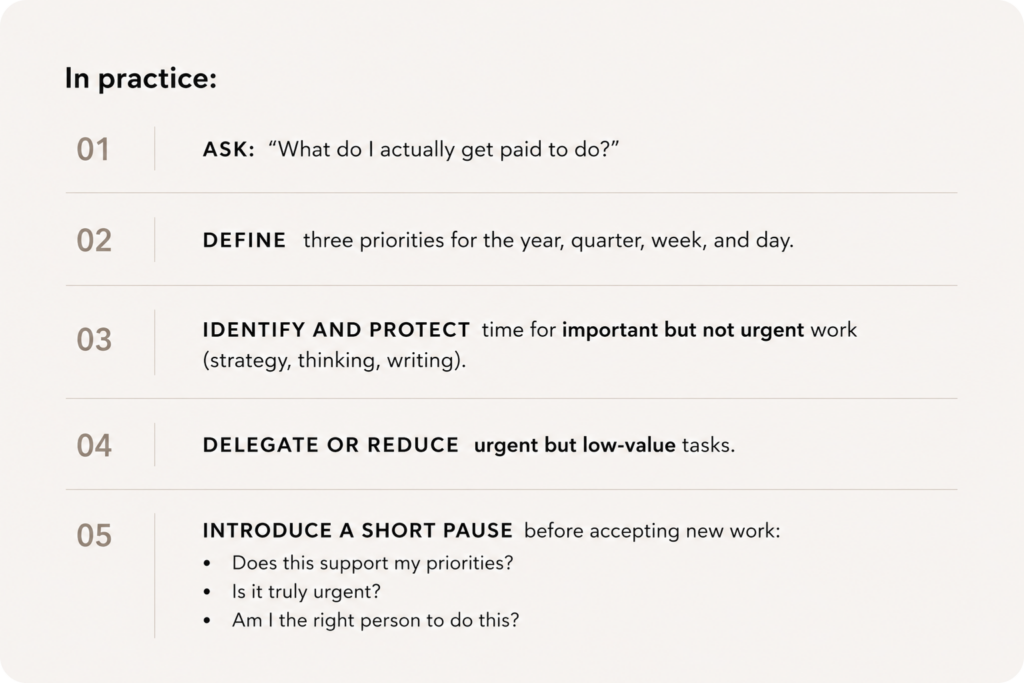
Ask (yourself) what you actually get paid for. A useful question to guide prioritisation is simple: What do I actually get paid to do? For a researcher, this may involve developing ideas, analysing results, and writing. For a leader, it may include setting direction, making decisions, and developing people. Activities that do not directly contribute to these outcomes should not dominate the calendar.
There can only be so many priorities. Tuominen and Pohjakallio, in their analysis of modern working life in The Workbook, propose a simple but powerful structure: identify three priorities for the year, three for the quarter, three for the week, and three for the day. This structure forces focus across time horizons and ensures that meaningful work receives attention before urgent tasks take over the schedule.
Review where you actually spend your time. The classic practical tool for examining how time is currently spent is the Eisenhower Matrix, which distinguishes between urgency and importance. When professionals review their calendars through this lens, a common pattern emerges: urgent but low-value tasks dominate the schedule, while important but not urgent work – such as thinking, planning, and relationship building – receives little protected time. Yet these activities are precisely what drive long-term progress.
Handling ad‑hoc requests is part of this discipline. Before accepting new tasks, it helps to pause and ask a few simple questions: Does this support my priorities? Is it truly urgent? Am I the right person to do it? What happens if it waits? This brief reflection creates a buffer between request and reaction and protects meaningful work.
2. Work with your natural energy rhythms
Even with clear priorities, planning often fails when work is scheduled without considering how human energy naturally fluctuates – daily and weekly.
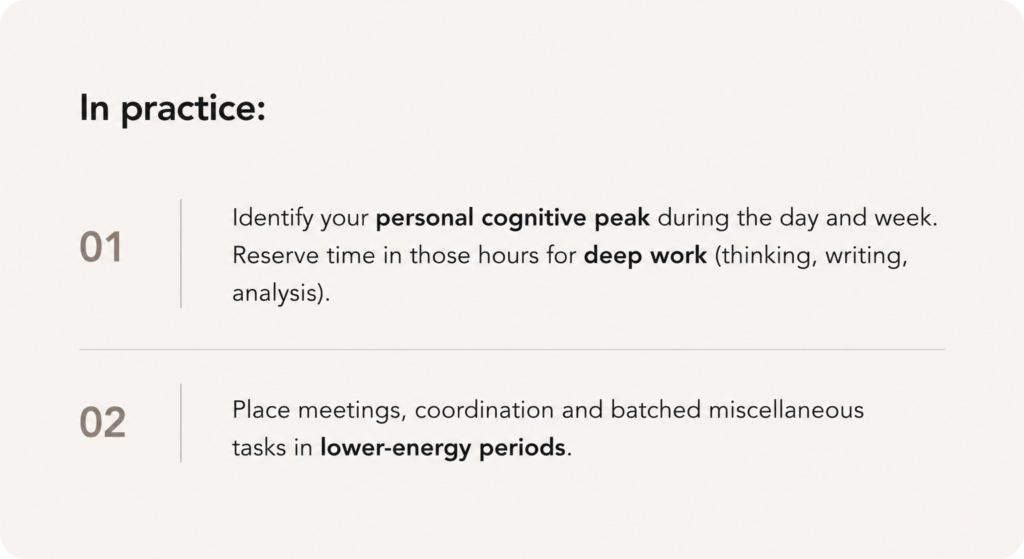
Most professionals recognize that cognitive energy follows patterns during the week. For many people, mental freshness and motivation are highest at the beginning of the week, when strategic thinking and creative work feel easier. As the week progresses and cognitive load accumulates, attention and decision quality may decline. Recognizing this pattern allows demanding work – such as strategy development, complex analysis, or major decisions – to be scheduled earlier in the week, while lighter coordination or administrative tasks can be placed later.
Identify your chronotype and peak hours of the day. Within each day, performance is shaped by circadian rhythms, the roughly 24-hour biological cycle that regulates alertness and sleep–wake patterns. These rhythms differ across individuals. Some people naturally reach peak cognitive performance earlier in the day (“morning types”), while others perform best later (“evening types”). Understanding one’s own pattern makes it possible to schedule deep work—writing, analysis, or complex problem solving – during periods of highest personal alertness.
3. Treat recovery as a strategic advantage
In sport, the ability to recover well often separates elite performers from amateurs. Top athletes do not simply train harder—they manage recovery deliberately so they can perform again the next day.The same principle applies to cognitive work.
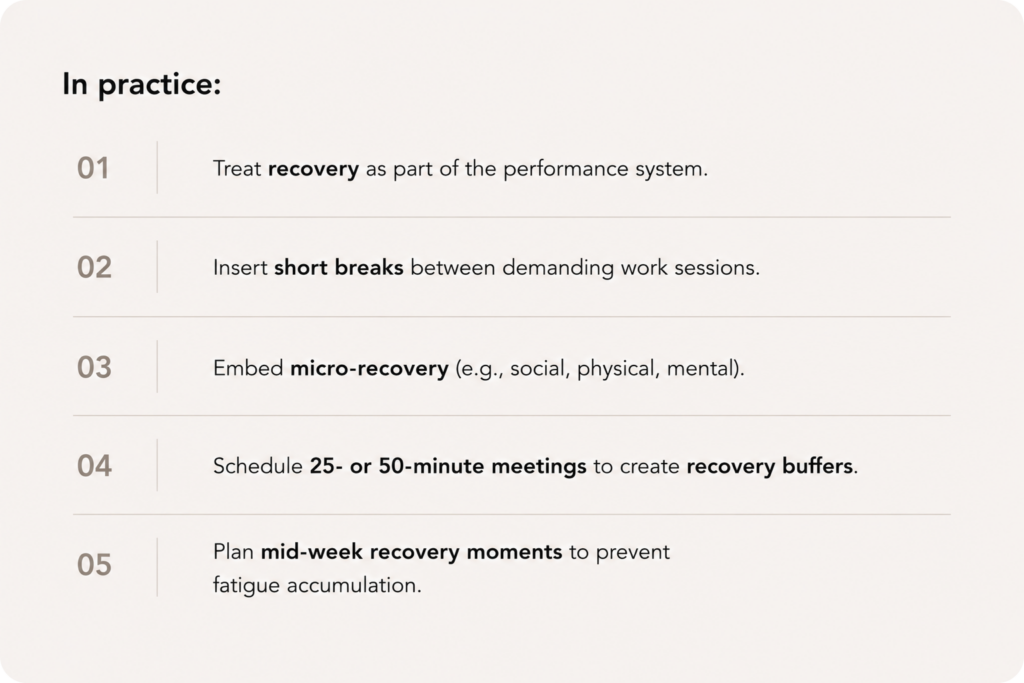
Sustained performance depends on alternating periods of effort and recovery. Research on ultradian rhythms – natural cycles of alertness – suggests that the brain can sustain intense concentration for only about 60–90 minutes at a time before attention begins to decline. Short recovery periods allow the brain to reset and restore cognitive resources.
Micro-break for better energy and vigor. Even brief breaks – stepping away from the screen, socializing, taking a short walk, or stretching – can improve the sense of energy and vigor. These micro-recovery moments become particularly important on days that include several demanding work sessions. A great way to build micro-recovery into the system is by scheduling 25- or 50-minute meetings instead of the standard 30 or 60 minutes automatically creates short buffers.
Energy management also matters across the week. Because cognitive fatigue accumulates over time. Many people experience Wednesday as “hump day,” the point in the week when the accumulated demands of work begin to catch up. Mid-week recovery practices – such as exercise, time outdoors, or intentionally lighter work blocks – can help maintain performance through the end of the week.
Rather than slowing productivity, these recovery practices help sustain clarity, creativity, and decision quality.
4. Design your schedule around “race days”
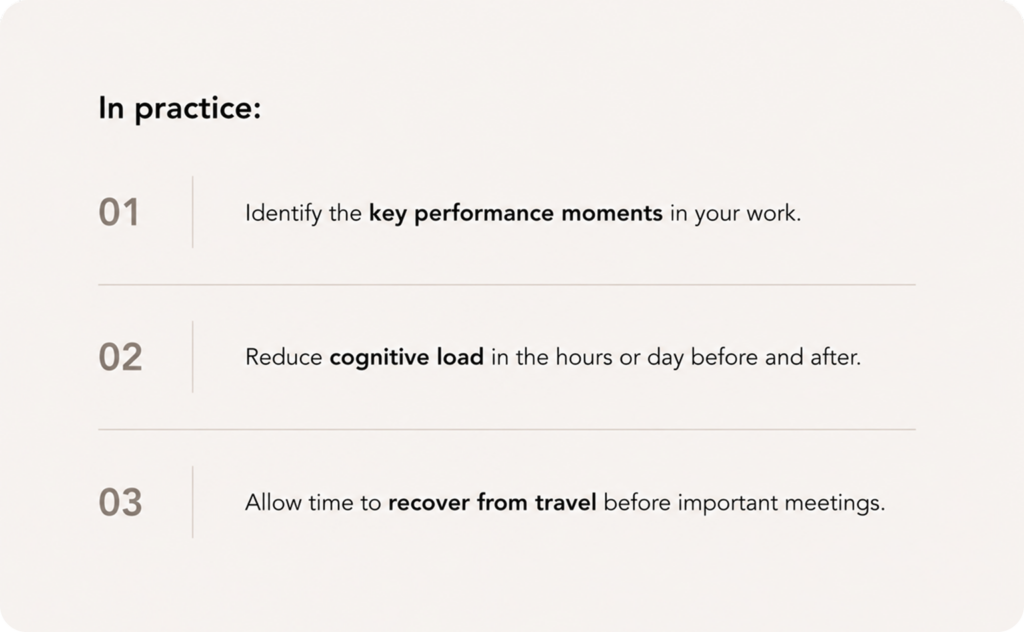
Athletes structure their training around competitions. Knowledge work often contains similar high-impact moments: an important presentation, a strategic decision meeting, a major client negotiation, or a critical milestone in a project.
“Tapering” to peak performance moments. In the days leading up to an important race, training intensity is often reduced – a process known as tapering – to ensure that the body is rested and energy reserves are fully restored. Athletes also carefully manage travel and logistics to minimize fatigue. Arriving early enough to adjust to travel, sleep patterns, or time zones helps ensure that performance is not compromised by avoidable strain.
Post-race recovery. Just as important is what happens after the competition. Recovery – through rest, light activity, or reduced cognitive and emotional load – allows the body and mind to reset before returning to normal training. During intense effort, the body activates a stress response, increasing hormones such as adrenaline and cortisol to mobilise energy and sharpen focus. Recovery allows these systems to return to homeostasis, restoring hormonal balance, replenishing energy stores, and repairing tissues.
Deliberate strategizing. Rather than approaching these moments reactively, professionals can structure their schedules to support performance. This may involve reducing workload beforehand, allowing time to recover from travel, and protecting preparation time. Equally important is allowing space afterward to reset before moving back into routine work.
5. Plan for the realities of life
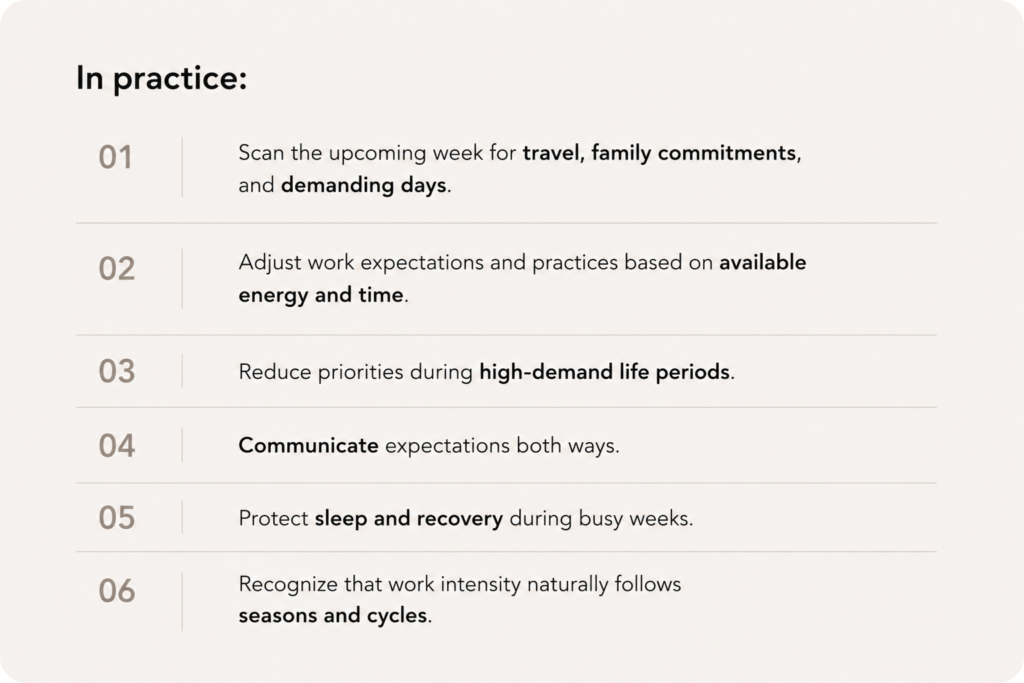
Work does not happen in isolation. Family responsibilities, travel, health, and personal commitments all influence how much energy is available for professional tasks. Effective planning therefore considers the broader rhythm of life, not just the demands of work.
At times, work itself requires additional focus. An important deadline, a major presentation, or a strategic project may temporarily demand more time and cognitive energy. During these periods, it often helps to reduce commitments elsewhere and protect the time needed to deliver high-quality work.
At other times, demands arise outside work. A child may become ill, family responsibilities may increase, or personal recovery may require greater attention. In these weeks, work priorities may need to be temporarily simplified to match the available energy.
Most weeks hopefully allow for a reasonable balance between these domains. Occasionally, however, demands accumulate across multiple areas at the same time – an important work deadline coinciding with unexpected family responsibilities, for example. These “chaos weeks” require deliberate reprioritisation: identifying what truly needs to be done now, what can wait, and where support may be needed.Communication is essential because work and life draw from the same energy reserve. When major deadlines, travel, or personal responsibilities increase demands in one area, it inevitably affects capacity in others. Making these demands visible helps align expectations and allows colleagues and family members to coordinate support.
Optimise, don’t maximise
My father, Aki Hintsa, summarized sustainable high performance with a simple principle: “Optimise, don’t maximise.” Sustainable high performance rarely comes from trying to maximise every hour of the day. Instead, it comes from optimising how work, energy, and recovery interact over time.
In the end, sustainable performance is not about doing more.
It is about doing the right work, at the right time, with the energy to do it well.