Why Good Leaders Struggle Under Pressure – 5 Things You Can Do Differently

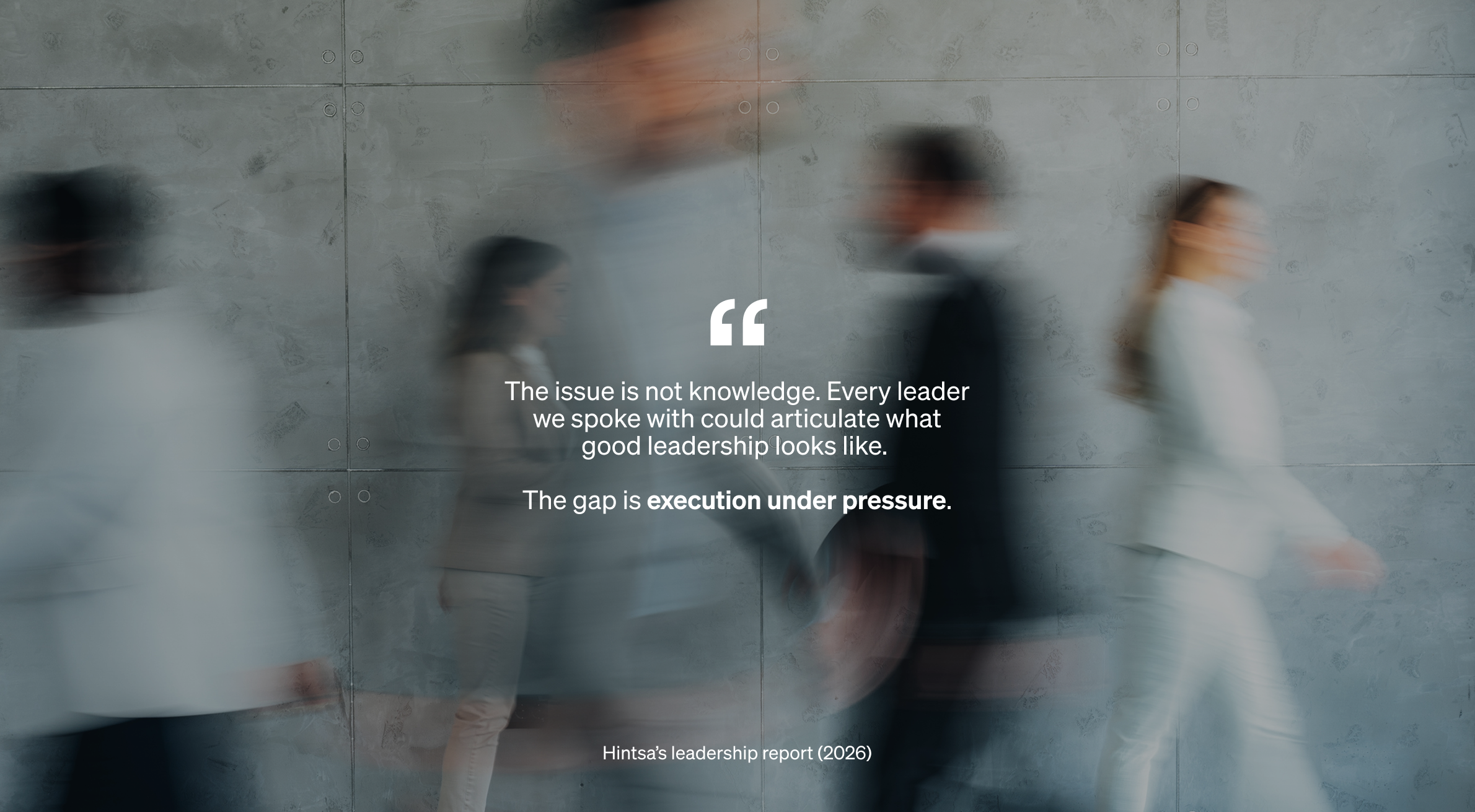
Most leaders know what good leadership looks like. But knowing what to do and doing it under pressure are two very different things.
In 2026, Hintsa interviewed 24 senior leaders and leadership experts across 10 industries and four continents. The research revealed a consistent challenge: leaders don’t necessarily lack the skills to lead well. They struggle to apply them when pressure builds.
Here are five key lessons from the findings, and what leaders can take away from them.
1. Pressure is no longer temporary
Leadership has always involved pressure. What’s changed is that it rarely lets up.
Geopolitical uncertainty, economic challenges, AI acceleration, and organisational transformation are happening simultaneously. Yet many organisations still operate as if pressure comes in cycles, with periods of stability and recovery in between.
As one leader from a global industrial technology company explained: “We don’t have task force phases and recovery phases anymore. It’s continuous, what’s happening in China, in the US, how is the crisis in Middle East developing. You do not have enough normal business anymore in the meantime.”
What you can do differently: Stop treating every challenge as a temporary sprint. Build ways of working that allow your team to adapt, maintain performance, and recover even when uncertainty continues.
2. Pressure changes how we lead
Most leaders understand the importance of staying calm, communicating clearly, and making thoughtful decisions. But under pressure, some become controlling, others withdraw, and long-term thinking gives way to immediate problems.
The research highlights a gap between the leader we intend to be and the leader we become under sustained pressure.
As an Executive Development Director at a global business school explains: “When you are tired and burnt out, having difficult conversations is hardest — not because you don’t know how, but because you haven’t got the clarity or the energy.”
These changes in behaviour don’t just affect the individual leader. They can influence how the entire team responds to pressure and uncertainty.
What you can do differently: Pay attention to how your behaviour changes under pressure. Do you become more controlling, withdraw, or avoid difficult conversations? Recognising your patterns is the first step towards responding more intentionally.
3. More information doesn’t always mean better decisions
Today’s leaders have more information at their fingertips than ever before, yet less time to make sense of it.
Constant communication, competing priorities, and digital distractions fragment attention. Even AI, despite its promise to reduce workloads, can create new demands as information flows faster and the expectation to respond grows.
As one Founder & CEO described: “Instead of thinking — great, someone’s working on my behalf — you become the bottleneck. The agent doesn’t sleep. And that creates the feeling that you also have to be always on.”
The problem isn’t simply information overload. It’s the disappearance of thinking time, leaving leaders reacting rather than reflecting.
What you can do differently: Make thinking time a deliberate part of your working week. Protect space away from meetings and messages to reflect, challenge assumptions, and focus on decisions that matter.
Want to explore the findings further?
Discover insights from 24 senior leaders on the critical gap in leadership development.
download the full report4. Personal performance is a leadership capability
Organisations invest heavily in leadership development, yet the research uncovered a striking omission. Across the organisations represented in the interviews, sustainable performance wasn’t defined as a core leadership capability.
Instead, health, wellbeing, and recovery were largely treated as personal responsibilities, separate from leadership development. Even when unsustainable workloads are recognised, organisations don’t necessarily act.
As a Director at a global professional services firm explained: “We’ll see somebody that’s 175% utilised on a four-week rolling average. And we’ll just go, oh, that’s interesting. I don’t think we’d ever make the decision to say we’re taking you off this for a bit.”
What you can do differently: Treat your energy, recovery, and ability to focus as leadership priorities, not personal matters to address when there’s time left over. Consider how personalised performance coaching could help you build these foundations, and whether the expectations you set for your team support sustainable performance.
5. Your behaviour sets the standard
Organisations can invest in wellbeing programmes and promote sustainable performance, but their culture is ultimately shaped by what leaders do.
When senior leaders consistently sacrifice recovery, work through holidays, or treat exhaustion as commitment, those behaviours become the unwritten expectations for everyone else.
As an Executive Development Director of a global business school puts it: “If you want to embed sustainable performance in your organisation, the only thing that actually works is a leader two levels up who does it — visibly, consistently, without apology. Everything else is a programme. And programmes don’t cascade. Behaviour does.”
The research also suggests that the next generation of leaders isn’t necessarily rejecting ambition. They’re increasingly questioning whether personal sacrifice should be the unavoidable price of leadership.
What you can do differently: Consider what your team learns from watching you. Are you demonstrating the habits, boundaries, and behaviours you want others to adopt, particularly when work gets demanding?
The critical gap in leadership development
The research points to a fundamental problem: organisations invest in developing leadership skills, but often overlook the conditions leaders need to put those skills into practice.
Leaders attend excellent programmes, learn new approaches, and return to workplaces where the same pressures remain. The knowledge is there, but the capacity to apply it consistently may not be.
At Hintsa, we see sustainable performance as the missing foundation: the physical, mental, and behavioural capacity that enables leaders to apply their skills and sustain performance under pressure.
Through our executive coaching and leadership development programmes, we help leaders build that capacity, so they can perform at their best even when conditions are anything but favourable.